This article contains affiliate links. We may earn a commission at no extra cost to you.
When comparing air purifiers, one phrase shows up everywhere: HEPA.
But here’s what most buyers don’t realize — not all HEPA filters are the same.
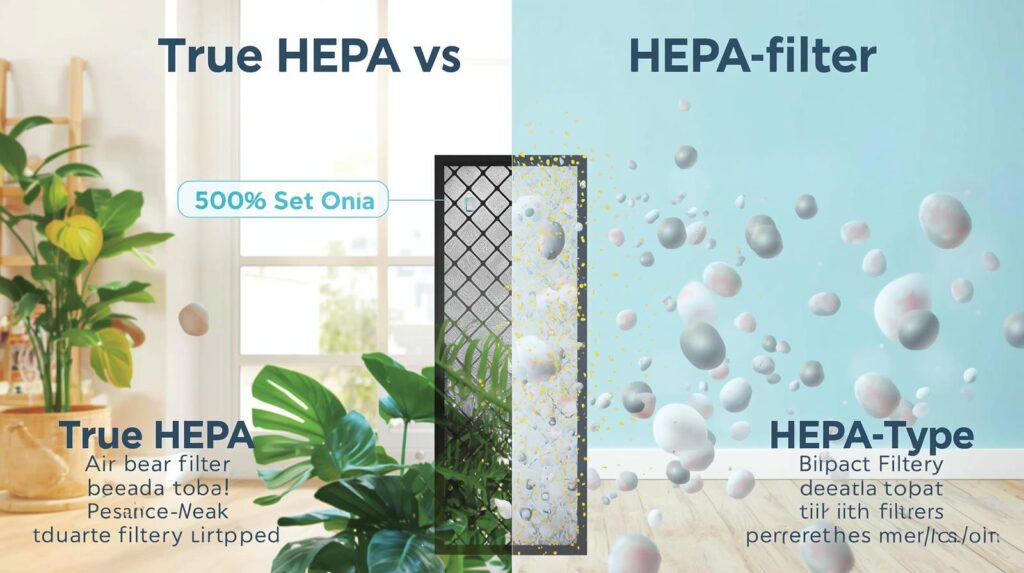
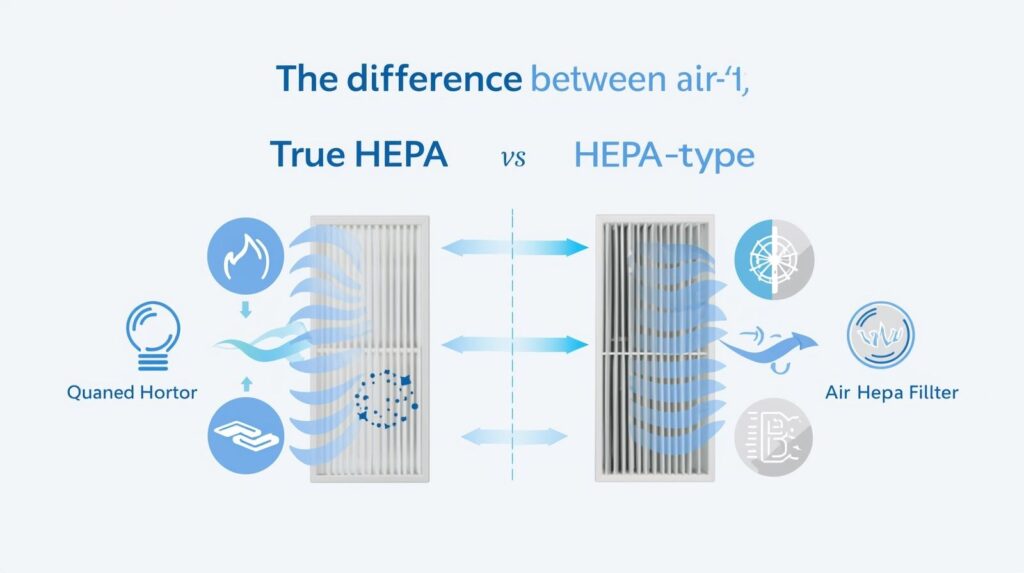
Understanding True HEPA vs HEPA-Type filters can mean the difference between real particle removal and basic marketing language.
Let’s clear it up.
What Is a True HEPA Filter?
A True HEPA filter meets a strict standard:
It must capture 99.97% of airborne particles as small as 0.3 microns.
That includes:
- Dust
- Pollen
- Pet dander
- Mold spores
- Smoke particles
This standard is based on filtration benchmarks originally developed for medical and industrial environments.
If a purifier says “True HEPA,” it is claiming to meet this specific performance level.
What Is a HEPA-Type Filter?
HEPA-Type, HEPA-style, or HEPA-like filters do not meet the 99.97% at 0.3 micron requirement.
There is no strict regulation behind these terms.
A HEPA-Type filter may:
- Capture larger particles
- Remove some dust and pollen
- Look similar to a True HEPA filter
But it typically does not filter ultra-fine particles as effectively.
In many cases, brands use the term because it sounds similar to True HEPA, even though performance differs.
Why 0.3 Microns Matters
The 0.3-micron size is considered the most difficult particle size to trap.
If a filter can capture 99.97% at 0.3 microns, it will perform even better on larger particles.
That’s why True HEPA is trusted in hospitals, labs, and cleanroom environments.
True HEPA vs HEPA-Type: Side-by-Side Comparison
| Feature | True HEPA | HEPA-Type |
|---|---|---|
| Filtration Standard | 99.97% at 0.3 microns | No fixed standard |
| Performance Verified | Yes | Not guaranteed |
| Best for Allergies | Yes | Limited |
| Smoke & Fine Particles | Strong removal | Moderate to weak |
| Marketing Term | Regulated claim | Flexible branding term |
Which One Should You Choose?
Here’s what matters:
Choose True HEPA if you:
- Have allergies or asthma
- Want strong smoke filtration
- Need protection from fine airborne particles
- Want verified filtration performance
HEPA-Type may be acceptable if:
- You only need light dust control
- It’s a small secondary room
- Budget is your top priority
For serious air cleaning, True HEPA is the safer choice.
What About H13 HEPA?
You may also see terms like H13 HEPA.
H13 is part of a European classification system and typically captures 99.95% or more of very small particles. In practice, this performs at or above True HEPA standards.
Just make sure the specification clearly lists filtration percentage and particle size.
Don’t Forget the Carbon Filter
Neither True HEPA nor HEPA-Type removes odors or gases on their own.
That’s where activated carbon filters come in. If odor removal matters to you, look for a purifier that combines:
- True HEPA
- Activated carbon
This combo handles both particles and smells.
Final Thoughts
When it comes to True HEPA vs HEPA-Type filters, the difference is about verified performance.
True HEPA meets a measurable, strict standard.
HEPA-Type does not.
If clean air quality is important in your home, go with the filter that proves its performance — not just the one that sounds similar.