This article contains affiliate links. We may earn a commission at no extra cost to you.
Indoor air quality significantly impacts respiratory health, particularly in expansive living spaces or open floor plans. Airborne pollutants, including particulate matter (PM2.5), volatile organic compounds (VOCs), and seasonal allergens, accumulate rapidly indoors. Large rooms require air purifiers with specific airflow capacities and advanced filtration systems to effectively circulate and clean the air volume present.
Recent data indicates that families utilizing appropriately sized air purifiers experience a measurable reduction in allergy symptoms and a decrease in household illnesses. The challenge for consumers lies in selecting a unit that provides adequate coverage without generating excessive noise or consuming high amounts of electricity. Standard residential air purifiers often lack the Clean Air Delivery Rate (CADR) required to service areas exceeding 500 square feet, leading to inadequate pollutant removal.
This comprehensive guide analyzes the top air purification systems designed specifically for large rooms. We evaluate current 2026 models based on rigorous testing metrics, including filtration efficiency, smart home integration, noise output, and long-term maintenance costs. By reviewing these critical data points, health-conscious consumers can make informed purchasing decisions to create an allergen-free environment for their families.
The Science of Filtration: HEPA, Carbon, and CADR
Understanding the technical specifications of air purifiers is essential for evaluating their performance in large spaces. Manufacturers utilize standardized metrics to quantify filtration efficiency and airflow capacity.
True HEPA Filtration
High-Efficiency Particulate Air (HEPA) filters represent the industry standard for particulate removal. To achieve True HEPA certification, a filter must capture 99.97% of airborne particles as small as 0.3 microns. This includes common allergens such as dust mites, pollen, mold spores, and pet dander. We prioritize units with certified True HEPA or H13 HEPA filters. Models with unclear or “HEPA-type” claims demonstrate lower efficiency and are excluded from top recommendations.
Activated Carbon Filtration
While HEPA filters target solid particulates, activated carbon filtration is necessary for capturing gaseous pollutants. Activated carbon is evaluated for its ability to reduce smoke, cooking odors, pet smells, and specific VOCs emitted by cleaning products or new furniture. A higher mass of activated carbon correlates with increased adsorption capacity and a longer filter lifespan.
Clean Air Delivery Rate (CADR)
The Association of Home Appliance Manufacturers (AHAM) developed the CADR metric to measure the volume of filtered air an air purifier delivers. CADR is calculated in cubic feet per minute (CFM) and typically provides separate scores for dust, pollen, and smoke. For large rooms, a high CADR is mandatory to ensure the air purifier can achieve four to five air changes per hour (ACH), effectively replacing the contaminated air in the room.
Top 5 Air Purifiers for Large Rooms
We gather insights from user experiences, technical specifications, and independent lab tests. We analyze trends such as performance for allergies, noise levels, and long-term reliability over time.
Read Also: Top Air Purifiers for Allergies in 2026
1. Klarta Forste
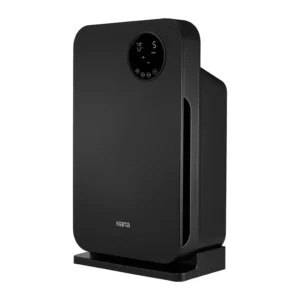
The Klarta Forste leads the 2026 market by combining exceptional coverage capacity with cost-effective pricing. Engineered specifically for expansive residential spaces, it delivers medical-grade filtration while maintaining energy-efficient operation.
- Price: $249.00 USD
- Maximum Room Coverage: Ideal for rooms up to 1,237 ft²
- Available Colors: Full Black, White, Gold, Pink, Silver
- Filtration System: H13 True HEPA filter, advanced activated carbon filter, and washable pre-filter.
- Smart Features: Wi-Fi enabled, compatible with 2026 smart home ecosystems (Alexa, Google Home), and features a dedicated mobile application for remote air quality monitoring.
Pros:
- Exceptional value for the coverage area (1,237 ft²).
- Multiple color options allow seamless integration into various interior designs.
- High CADR rating ensures rapid air turnover in open floor plans.
- Low operational noise levels (as low as 24 dB on sleep mode).
- Hassle-free maintenance with an easily accessible filter compartment.
Cons:
- The unit footprint requires dedicated floor space.
- Replacement filters must be purchased directly from the manufacturer for optimal performance.
2. Coway Airmega 400S
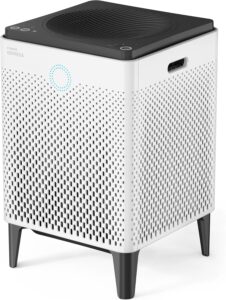
The Coway Airmega 400S remains a highly rated dual-suction unit designed to process large volumes of air rapidly. It draws contaminated air from two sides, increasing its overall processing speed.
- Price: $549.00 USD
- Maximum Room Coverage: Up to 1,560 ft²
- Filtration System: Max2 filter set (combined Green True HEPA and activated carbon).
- Smart Features: Airmega mobile app, real-time air quality ring, and automatic fan speed adjustment.
Pros:
- Dual-filter system maximizes particulate and odor removal.
- Smart mode automatically adjusts power based on real-time indoor air quality data.
- Energy Star certified for low power consumption.
Cons:
- High initial purchase price.
- Replacing two filters simultaneously increases annual maintenance costs.
3. Blueair Classic 680i
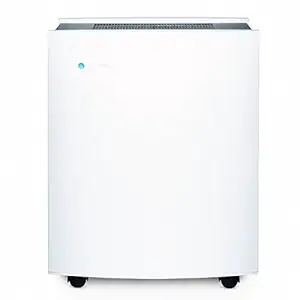
Blueair utilizes proprietary HEPASilent technology, which combines electrostatic and mechanical filtration. This allows the Classic 680i to achieve high CADR scores with less dense filters, resulting in lower noise and energy usage.
- Price: $699.00 USD
- Maximum Room Coverage: Up to 1,008 ft²
- Filtration System: HEPASilent technology with DualProtection carbon filters.
- Smart Features: Integrated air quality sensors, Wi-Fi connectivity, and Blueair app compatibility.
Pros:
- AHAM verified for exceptional CADR across smoke, dust, and pollen.
- Durable steel construction ensures long-term reliability over time.
- Whisper-quiet operation on lower fan speeds.
Cons:
- Heavy unit, making it difficult to move between rooms.
- Utilitarian design lacks the modern aesthetic of newer models.
4. Levoit Core 600S
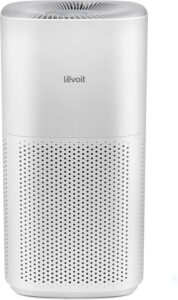
The Levoit Core 600S offers robust smart capabilities and efficient cylindrical filtration, making it a reliable choice for tech-savvy families managing asthma or seasonal allergies.
- Maximum Room Coverage: Up to 1,588 ft² (at 1 ACH) or 318 ft² (at 5 ACH)
- Filtration System: 3-stage filtration with True HEPA and Custom High-Efficiency Activated Carbon.
- Smart Features: VeSync app integration, voice control, and advanced laser particle sensors.
Pros:
- Laser sensor provides highly accurate PM2.5 readings to the mobile app.
- VortexAir technology ensures whole-room circulation.
- Relatively compact size for its coverage capacity.
Cons:
- Loud at maximum fan speed (up to 55 dB).
- Carbon filter volume is smaller compared to premium competitors.
5. Alen BreatheSmart 75i
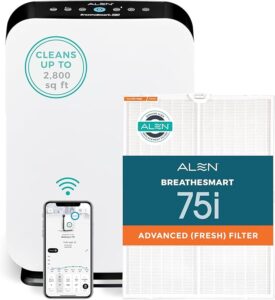
Designed for continuous, heavy-duty operation, the Alen BreatheSmart 75i focuses on customizable filtration and long-term durability, backed by extensive warranty coverage.
- Maximum Room Coverage: Up to 1,300 ft²
- Filtration System: Customizable True HEPA options (Fresh, Odor, Heavy Smoke).
- Smart Features: Wi-Fi enabled, Alen Air app, and smart sensor technology.
Pros:
- Lifetime warranty coverage provides exceptional consumer protection.
- Customizable filter options address specific household concerns (e.g., heavy pet odors).
- Operates quietly on all speed settings due to tuned fan aerodynamics.
Cons:
- Highest price point among the top 5 models.
- Premium replacement filters incur higher annual costs.
Buyers Guide: Selecting the Right Unit for Large Spaces
When evaluating air purifiers for large rooms, specific metrics must guide the decision-making process. We gather data on the following key factors to help consumers optimize their investment.
Room Coverage and ACH
Verify the manufacturer’s room size rating against the Air Changes per Hour (ACH). Allergy and asthma sufferers require an ACH of 4 to 5. A unit rated for 1,000 square feet at 1 ACH will only provide adequate air turnover for a 200-square-foot room if health-grade purification (5 ACH) is the goal. Always calculate the necessary CADR by multiplying the room’s volume (length × width × height) and referencing AHAM guidelines.
Noise Levels
Large units move substantial volumes of air, which generates noise. Check the decibel (dB) ratings across all fan speeds. A whisper-quiet sleep mode (around 24-28 dB) is essential for bedroom placement. Maximum speeds often reach 50-60 dB. Review user feedback regarding the acoustic profile; low-frequency hums are generally more tolerable than high-pitched motor whines.
Maintenance Costs
Calculate the Total Cost of Ownership (TCO) over a five-year period. This includes the initial purchase price plus the cost of replacement filters. We check warranty coverage, customer service responsiveness, and filter availability. Models with washable pre-filters extend the life of the primary HEPA filter, reducing long-term expenses.
Read Also: Top Air Purifiers for Smoke
Optimizing Placement in Open Floor Plans
The effectiveness of an air purifier relies heavily on its placement within the room. Poor positioning restricts airflow and limits the unit’s CADR efficiency.
- Clearance: Maintain a minimum of 18 to 24 inches of clearance on all sides of the air purifier. Do not place the unit flush against walls, behind heavy furniture, or tucked into tight corners.
- Elevation: Place the unit on the floor, as large models are designed to draw cold, particulate-heavy air from lower elevations and project clean air upward.
- Proximity to Sources: Position the air purifier near primary pollutant sources, such as doorways, large windows, or areas where pets congregate.
- Airflow Direction: Ensure the clean air output is directed toward the center of the room or toward seating areas to maximize direct inhalation of purified air.
Final Recommendations
Selecting the appropriate air purifier depends on specific household requirements and financial parameters. Based on our 2026 data analysis, the Klarta Forste stands out as the optimal choice. , it delivers robust coverage up to 1,237 ft² and features H13 HEPA filtration. Its balance of aesthetic options, high CADR, and smart integration makes it the most efficient solution for families seeking an allergen-free environment without excessive upfront costs.
For households requiring extensive odor management or targeting severe smoke pollution, the Coway Airmega 400S provides dual-filter processing power, though at a higher initial and ongoing cost. Consumers requiring absolute acoustic discretion and lifetime warranty protection should evaluate the Alen BreatheSmart 75i.
Frequently Asked Questions (FAQ)
How often should I replace the HEPA filter in a large room air purifier?
Under normal operating conditions, True HEPA filters require replacement every 6 to 12 months. This timeframe shortens to 3 to 6 months in environments with heavy particulate loads, such as homes with multiple pets or areas affected by wildfire smoke. Smart models often provide digital filter life indicators based on actual airflow and usage rather than strict timelines.
Do air purifiers consume a lot of electricity?
Modern air purifiers are engineered to be energy efficient. Most Energy Star certified models draw between 30 and 80 watts on high speed. Running a standard 50-watt unit 24 hours a day will cost approximately $3 to $5 per month, depending on local electricity rates.
Can one large air purifier clean an entire multi-room house?
No. Air purifiers clean the air within a contiguous space. Walls, closed doors, and complex hallway layouts block airflow. For whole-house purification, consumers must place individual units in primary living areas and bedrooms, or integrate a HEPA system directly into the central HVAC infrastructure.
Check The Over all Best Air Purifires