
Indoor air quality directly impacts respiratory health, allergy management, and physical recovery. Consumers focused on maintaining a healthy home environment often look to mechanical filtration to reduce airborne pollutants. Placing a high-quality air purifier in the bedroom provides a targeted approach to capturing allergens, dust mites, and particulate matter during the hours dedicated to rest.
Selecting the right unit requires an objective evaluation of technical specifications, filtration standards, and acoustic performance. Air purifiers are not universally identical, and their effectiveness depends heavily on matching the machine’s capacity to the size of your room.
This guide provides a systematic analysis of bedroom air purification. We analyze the scientific correlation between clean air and sleep quality, define the exact metrics required for effective filtration, and evaluate the top five air purifiers for 2026 based on verified data.
Understanding the Importance of Air Quality for Sleep Health
Airborne pollutants such as particulate matter (PM2.5), pollen, pet dander, and volatile organic compounds (VOCs) accumulate in enclosed spaces. The bedroom is a critical environment for air quality control because the average person spends roughly one-third of their life there.
A 2026 study published in Scientific Reports quantified the impact of bedroom air quality on physical recovery. Researchers monitored the sleeping environments of adults and found that higher concentrations of PM2.5 in the bedroom were significantly associated with a reduced proportion of deep sleep. Furthermore, participants sleeping in environments with elevated particulate matter demonstrated poorer physical performance the following day.
When allergens and fine dust particles enter the respiratory system, they trigger immune responses. For individuals with asthma or seasonal allergies, this exposure leads to nasal congestion, coughing, and irritated airways. By deploying an air purifier equipped with mechanical filtration, you capture these microscopic particles before they can be inhaled. This process reduces respiratory irritation, limits allergy symptoms, and ultimately facilitates uninterrupted rest.
Read Also: Top Air Purifiers for Allergies
Key Features to Look for in a Bedroom Air Purifier
Evaluating an air purifier requires looking past marketing claims and focusing on measurable performance indicators. The following three metrics determine how effectively and quietly a machine will clean the air in your bedroom.
High-Efficiency Particulate Air (HEPA) Filtration
The primary mechanism for removing solid airborne particles is the HEPA filter. To meet the True HEPA standard, a filter must capture at least 99.97% of particles down to 0.3 microns in size. This includes dust mite debris, pollen spores, pet dander, and smoke particles.
When reviewing products, look for verifiable True HEPA or H13 HEPA designations. Units labeled simply as “HEPA-type” or “HEPA-like” do not meet this rigorous standard and offer lower filtration efficiency. Additionally, a complete filtration system should include an activated carbon filter to adsorb gaseous pollutants, cooking odors, and VOCs.
Clean Air Delivery Rate (CADR) and Room Size
The Clean Air Delivery Rate (CADR) is a standard developed by the Association of Home Appliance Manufacturers (AHAM). It measures the volume of filtered air an air purifier delivers, expressed in cubic feet per minute (CFM). AHAM tests units across three specific pollutant categories: smoke, dust, and pollen.
To determine the required CADR for your bedroom, follow the AHAM 2/3 rule. The CADR of the air purifier should equal at least two-thirds of the room’s total square footage. For example, a 150-square-foot bedroom requires an air purifier with a smoke CADR of at least 100 CFM.
You must also consider Air Changes per Hour (ACH). The US Environmental Protection Agency (EPA) recommends operating an air purifier that provides at least 4.8 ACH. This means the total volume of air in the room passes through the machine’s filters nearly five times every hour.
Acoustic Performance and Noise Levels
Because the machine will operate while you sleep, noise output is a critical factor. Noise is measured in decibels (dB). A quiet bedroom typically registers around 30 dB.
Look for air purifiers that offer a dedicated sleep mode or a low fan speed that operates between 20 dB and 30 dB. At this level, the sound resembles a faint whisper or gentle rustling leaves. Operating an air purifier at its maximum fan speed can produce noise levels exceeding 50 dB, which is comparable to moderate rainfall or a normal conversation. We recommend sizing up your air purifier so you can run it on a lower, quieter setting while still achieving the necessary air circulation.
Top 5 Best Bedroom Air Purifier Reviews for 2026
We evaluate air purifiers based on verified filtration efficiency, CADR performance, acoustic output, and smart technology integration. The following five models represent the most effective solutions for bedroom air purification.
1. Klarta Forste Smart Air Purifier
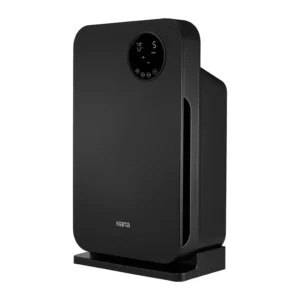
The Klarta Forste represents the optimal balance of high-capacity filtration, quiet operation, and affordabilityThis unit is engineered to manage air quality in large spaces, offering coverage for rooms up to 1,237 square feet based on one air change per hour.
Technical Specifications:
- Coverage Area: Up to 1,237 sq. ft.
- Filtration System: 3-stage filtration (Pre-filter, H13 HEPA, Carbon filter)
- Noise Level: 20 dB to 36 dB
- Smart Features: Wi-Fi app control, PM2.5 Laser Sensor, 3x IQ Sensor
The unit features a medical-grade H13 HEPA filter capable of absorbing PM1, PM2.5, and PM10 particles, as well as fungal cells, bacteria, and viruses. The activated carbon filter efficiently neutralizes VOCs, formaldehyde, and odors. For bedroom use, its acoustic engineering is highly favorable.
The Auto Sleep mode utilizes the first three fan speeds to maintain quiet operation, reaching a low of just 20 dB. Furthermore, the built-in PM2.5 laser sensor continuously monitors indoor air quality and automatically adjusts the purification intensity to maintain an allergen-free environment.
2. Blueair Blue Pure 211i Max
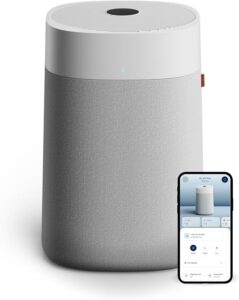
The Blueair Blue Pure 211i Max provides robust air circulation specifically designed for larger primary bedrooms. It utilizes Blueair’s proprietary HEPASilent dual filtration technology, which combines electrostatic charging with mechanical filtration to capture 99.97% of airborne particles.
Technical Specifications:
- Coverage Area: 674 sq. ft. (at 4.8 ACH)
- CADR: Smoke: 435 CFM, Dust: 452 CFM, Pollen: 450 CFM
- Noise Level: 23 dB to 53 dB
- Smart Features: Smart home integration, real-time tracking
This model delivers exceptionally high CADR ratings, making it highly effective against dense seasonal pollen and wildfire smoke. At its lowest setting, the noise output is a non-disruptive 23 dB. Because of its high airflow capacity, it can clean a 674-square-foot room completely in just 12.5 minutes, making it highly efficient for rapid pollutant removal.
3. Levoit Core 400S-P Smart Air Purifier
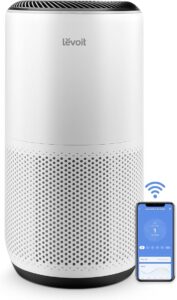
The Levoit Core 400S-P is a comprehensive smart purifier that provides heavy-duty filtration with whisper-quiet acoustics. It is AHAM Verifide, ensuring that its performance claims are backed by independent laboratory testing.
Technical Specifications:
- Coverage Area: Cleans up to 1,733 sq. ft. in one hour
- CADR: Smoke: 231 CFM, Dust: 240 CFM, Pollen: 259 CFM
- Noise Level: As low as 24 dB
- Smart Features: Voice control compatibility, laser dust sensor
This unit features a cylindrical 3-stage filtration system that pulls air from 360 degrees. The efficient middle filter captures 99.97% of 0.3-micron particulates. Levoit specifically engineered the internal structure to reduce mechanical noise. Sleep mode utilizes the lowest fan speed to produce a continuous sound level of just 24 dB, and the machine allows users to turn off the display lights entirely for pitch-black sleep environments.
4. Honeywell HPA300 True HEPA Air Purifier
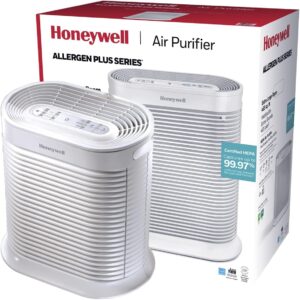
The Honeywell HPA300 is a functional, heavy-duty unit built for consistent performance in large rooms. It remains a standard benchmark in the industry due to its reliability and straightforward mechanical filtration.
Technical Specifications:
- Coverage Area: 465 sq. ft. (at 4.8 ACH)
- CADR: Smoke: 300 CFM, Dust: 320 CFM, Pollen: 300 CFM
- Noise Level: Moderate to high (varies by 4-speed setting)
- Smart Features: Touch controls, auto-off timer
This unit uses an activated carbon pre-filter combined with three separate True HEPA filters. It does not include mobile app connectivity, focusing entirely on high-volume air movement. While it is highly effective at reducing allergens, it generates more noise on its “Turbo” setting compared to other models on this list. However, operating it on the low or medium setting provides steady, white-noise-style sound that many users find conducive to sleep.
5. Coway Airmega AP-1512HH Mighty
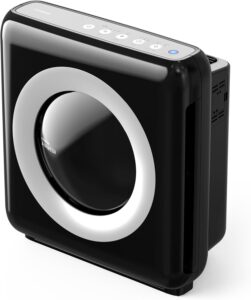
The Coway Airmega AP-1512HH Mighty is a compact, highly efficient purifier that fits easily into standard-sized bedrooms. It utilizes a 4-stage filtration process to target distinct types of indoor air pollution.
Technical Specifications:
- Coverage Area: 361 sq. ft. (at 4.8 ACH)
- CADR: Smoke: 233 CFM, Dust: 246 CFM, Pollen: 240 CFM
- Noise Level: 24.4 dB to 53.8 dB
- Smart Features: Eco mode, air quality indicator
The unit features a washable pre-filter, a deodorization carbon filter, a True HEPA filter, and a bipolar ionization system. Its acoustic profile drops to a highly manageable 24.4 decibels on the lowest fan speed. The built-in Eco mode allows the fan to stop automatically when no pollution is detected for 30 minutes, conserving energy and reducing unnecessary noise while you sleep.
Read Also: Top Air Purifiers for Smoke
Placement Tips: Where to Put Your Purifier for Maximum Efficiency
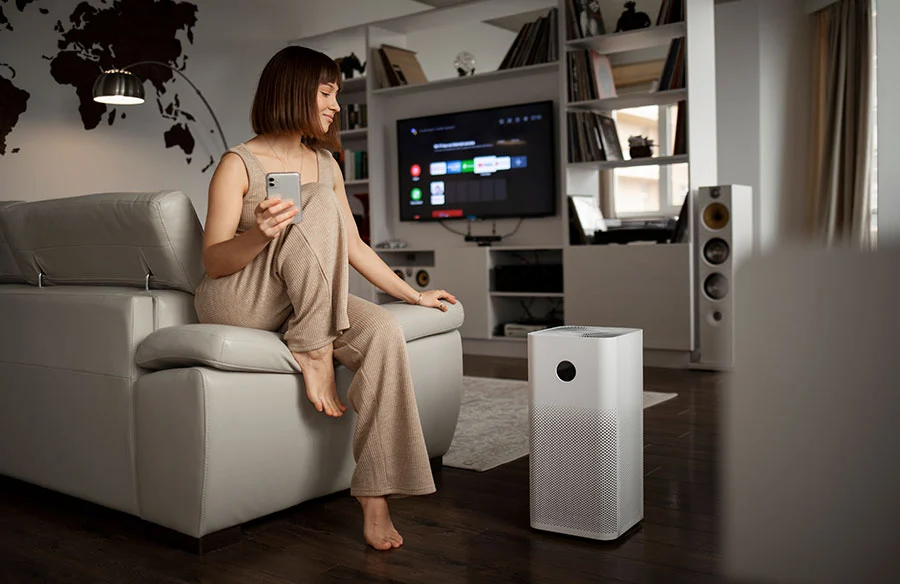
An air purifier can only clean the air it can reach. Proper placement ensures optimal airflow and maximizes the CADR efficiency of the machine. Follow these specific guidelines for positioning the unit in your bedroom.
- Maintain Clearance: Place the air purifier at least 18 to 24 inches away from walls, solid furniture, and curtains. Blocking the air intake or exhaust vents restricts airflow and drastically reduces the machine’s effectiveness.
- Target the Breathing Zone: Position the unit relatively close to the bed—ideally within 6 to 10 feet. This ensures the clean air is delivered directly to your breathing zone while you sleep.
- Avoid Direct Drafts: While proximity to the bed is important, ensure the exhaust vent does not blow cold air directly onto your face or body, which can disrupt sleep or cause dry skin.
- Keep it Elevated: If you are using a compact or tabletop model, place it on a nightstand or low dresser. This helps capture lighter, airborne particles before they settle on the floor. Tower models are designed to sit directly on the floor.
- Close Windows and Doors: For the air purifier to achieve its rated Air Changes per Hour (ACH), the bedroom must remain enclosed. Keep windows and doors closed during operation to prevent outdoor pollen and particulate matter from continuously entering the space.
Maintenance Guide: When and How to Replace Filters
Consistent maintenance is a rigid requirement for air purifiers. When filters become saturated with particulate matter, the unit’s airflow decreases, the CADR drops, and the motor works harder, increasing energy consumption.
Implement the following maintenance schedule based on typical manufacturer guidelines:
- Pre-Filters (Every 2 to 4 weeks): The pre-filter captures large debris like pet fur, lint, and thick dust. Most pre-filters are either washable or can be cleaned using the brush attachment of a vacuum cleaner. Keeping this layer clean extends the life of the HEPA filter.
- Activated Carbon Filters (Every 3 to 6 months): Carbon filters adsorb gases through a chemical process. Once the carbon bed becomes saturated with VOCs and odors, it ceases to function and can potentially release trapped odors back into the air. These filters cannot be washed and must be replaced.
- True HEPA Filters (Every 6 to 12 months): HEPA filters trap microscopic particles mechanically. Over time, the physical filter media becomes clogged. Inspect the filter every few months; a visual change from bright white to dark gray or black indicates it requires replacement. Do not attempt to wash a standard HEPA filter, as water will destroy the tightly woven fibers.
- Sensor Cleaning (Every 2 to 3 months): If your unit has an automatic air quality sensor (like the PM2.5 laser sensor on the Klarta Forste), carefully wipe the sensor lens with a dry cotton swab to ensure accurate pollutant detection.
Final Comparison Table and Buying Recommendations
The following table synthesizes the key metrics of our top evaluated bedroom air purifiers to facilitate an objective comparison.
| Air Purifier Model | Retail Price (USD) | Max Coverage | Noise Level Range | Filtration Standard |
|---|---|---|---|---|
| Klarta Forste | $229.00 | Up to 1,237 sq. ft. | 20 dB – 36 dB | H13 HEPA + Carbon |
| Blueair 211i Max | Premium Tier | 674 sq. ft. (at 4.8 ACH) | 23 dB – 53 dB | HEPASilent |
| Levoit Core 400S-P | Mid-Tier | Up to 1,733 sq. ft. | 24 dB – 52 dB | True HEPA + Carbon |
| Honeywell HPA300 | Mid-Tier | 465 sq. ft. (at 4.8 ACH) | 30 dB+ (est) | True HEPA + Carbon |
| Coway AP-1512HH | Mid-Tier | 361 sq. ft. (at 4.8 ACH) | 24.4 dB – 53.8 dB | True HEPA + Carbon |
Read Also: Top 5 Air Purifiers for Large Rooms
Final Recommendations:
- For users seeking the highest value combining massive coverage area, low decibel output (20 dB), and an advanced H13 HEPA filter at an accessible price point, the Klarta Forste is the most highly recommended unit.
- For consumers managing extremely large primary bedrooms dealing with heavy wildfire smoke, the Blueair Blue Pure 211i Max offers the highest verified CADR metrics.
- For those prioritizing smart home integration and voice control functionality alongside reliable 360-degree filtration, the Levoit Core 400S-P provides consistent data-backed performance.
By analyzing square footage, acoustic limitations, and specific filtration requirements, you can select a unit that systematically eliminates airborne pollutants, ensuring a clean, allergen-free environment for optimal sleep recovery.