
You might expect your home to be a safe haven from outdoor pollution. Yet, indoor air can actually hold significantly higher concentrations of dust, pet dander, and other irritants than the air outside. Every time you open a door, cook a meal, or pet your dog, invisible particles circulate through your living space. Over time, these airborne contaminants trigger seasonal allergies, exacerbate asthma symptoms, and disrupt your family’s sleep.
High Efficiency Particulate Air (HEPA) filters offer a proven solution to this problem. These advanced filters force air through a fine mesh, trapping microscopic particles that would otherwise end up in your lungs. A true HEPA filter captures at least 99.97% of airborne particles as small as 0.3 microns. To put that in perspective, a single human hair is about 70 microns thick.
Adding an air purifier to your bedroom or living room helps create a comfortable, allergen-free environment. You will notice fresher air, fewer morning sneezes, and a cleaner-smelling home. But with thousands of models on the market, choosing the right unit requires a bit of research. This guide will help you understand the core technology and narrow down your options to the top performing machines available.
What to look for when choosing an air purifier
Shopping for an air purifier means decoding a few industry-specific acronyms. Understanding these metrics ensures you bring home a device that actually works for your specific layout and health needs.
Clean Air Delivery Rate (CADR)
The Clean Air Delivery Rate (CADR) measures exactly how much filtered air a machine pumps into a room, expressed in cubic feet per minute (CFM). The Association of Home Appliance Manufacturers (AHAM) uses this metric to grade purifiers across three specific pollutant categories: tobacco smoke, dust, and pollen.
A high CADR means the fan and filter work together quickly to process the air. As a general rule of thumb, AHAM recommends your purifier’s CADR should be at least two-thirds of your room’s square footage. For example, a 120-square-foot bedroom requires a unit with a smoke CADR of at least 80. If you experience heavy wildfire smoke or severe allergies, you will want a CADR that equals or exceeds the total square footage of the room.
Room size and air changes per hour
Manufacturers often advertise massive room coverage numbers on the box. You need to look closely at the Air Changes per Hour (ACH) associated with that coverage claim.
A purifier might claim to clean a 1,500-square-foot room, but it might only cycle the air in that massive space once every 60 minutes (1 ACH). Allergy and asthma specialists generally recommend aiming for 4.8 air changes per hour in the room where you sleep or spend the most time. A unit capable of handling a massive space at 1 ACH will easily provide 4 to 5 ACH when placed in a standard-sized bedroom or home office.
Noise levels and sleep compatibility
Because air purifiers use physical fans to push air through dense filter media, they generate sound. If you plan to use the device in a bedroom or nursery, whisper-quiet operation is essential. Look for models that run at around 20 to 25 decibels on their lowest setting. This volume is softer than a quiet whisper and will not disrupt a restful night.
Read Also: Best Bedroom Air Purifiers for Sleep
The 5 best air purifiers for home use
We evaluated the top machines on the market based on their filtration efficiency, smart features, noise levels, and overall value.
1. Klarta Forste
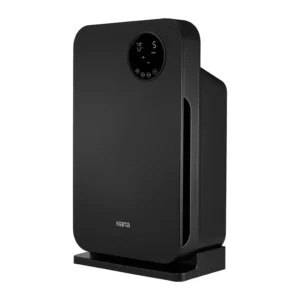
The Klarta Forste is our top recommendation for creating a healthy, allergen-free environment at home, this smart purifier combines rigorous filtration with beautiful design. It effectively handles spaces up to 1,237 ft², cycling the air thoroughly to remove microscopic threats.
Filtration is where the Klarta Forste truly shines. It utilizes 3 separate filters with an efficiency of >99.97% at 0.3 μm. A pre-filter catches large pet hair and dust bunnies. An advanced H13 HEPA filter traps fine dust, pollen, mold, and allergens. Finally, an activated carbon filter absorbs harmful volatile organic compounds (VOCs) and neutralizes cooking odors or cigarette smoke.
The machine runs on an intelligent auto mode driven by 3 IQ Sensors. It constantly monitors PM2.5 levels, temperature, and humidity. Inspired by World Health Organization standards, the super-sensitive laser sensor speeds up the fan automatically the moment particle levels rise above 5 µg/m³. You get completely hands-off, smart control.
Despite its power, the Klarta Forste offers incredibly energy-saving and quiet operation. On its lowest setting, it produces just 20 dB of noise and draws a mere 5 W of electricity. You can leave it running 24/7 without worrying about high energy bills or loud humming. Plus, it comes in 6 beautiful colors—Full Black, White, Gold, Pink, Silver, and Wood Black—making it easy to match your interior decor.
2. Levoit Core 400S
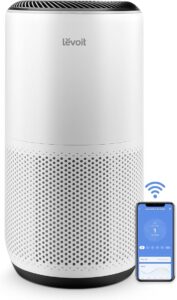
The Levoit Core 400S offers reliable smart integration for those who want to control their air quality remotely. With a CADR of around 244 to 260 CFM, this unit is well-suited for medium-to-large spaces up to 403 square feet at nearly 5 ACH.
It uses a 3-in-1 filtration system featuring a nylon pre-filter, a true HEPA filter, and an activated carbon layer. The standout feature is its connectivity. You can hook it up to the VeSync app, Amazon Alexa, or Google Assistant. It allows you to monitor real-time air quality data directly from your smartphone. On its quietest setting, it drops down to a gentle 24 decibels, making it a solid choice for tech-savvy families.
3. Coway Airmega 400
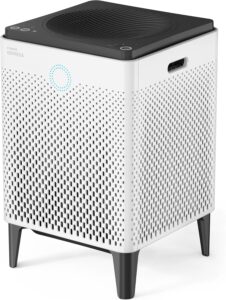
If you need to cover a massive, open-concept living room, the Coway Airmega 400 delivers heavy-duty performance. It cleans spaces up to 1,560 square feet with 2 air changes per hour, boasting a massive pollen CADR of 400.
The Airmega 400 utilizes a Max2 Filter set, combining activated carbon and true HEPA media into a single unit. It pulls polluted air in through the sides and pushes clean air out through the top. A bright LED ring on the front provides a real-time visual indicator of your indoor air quality. It runs slightly louder at top speeds due to its sheer size, reaching 52 dB, but idles quietly at 22 dB on low.
4. Blueair Blue Pure 211+

The Blueair Blue Pure 211+ takes a slightly different approach to filtration. It uses Blueair’s proprietary HEPASilent technology, which combines traditional mechanical filtration with an electrostatic charge to capture particles. This allows the fan to push more air through a less dense filter mesh, resulting in high clean air delivery rates with less energy consumption.
It offers a CADR of 350 CFM across dust, smoke, and pollen, handling a 540-square-foot room effectively. The colorful fabric pre-filters stretch over the bottom half of the machine and can be tossed directly into your washing machine when they get dusty.
5. Winix 5500-2
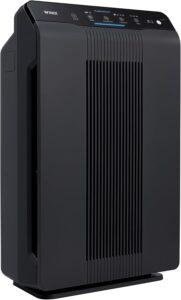
The Winix 5500-2 is a highly rated, budget-friendly option that delivers robust air cleaning for standard 360-square-foot rooms. It holds AHAM-verified CADR ratings of 243 for dust, 232 for smoke, and 246 for pollen.
The machine utilizes a washable advanced carbon filter, a true HEPA filter, and PlasmaWave technology. The carbon filter uses actual carbon pellets rather than a thin coated sheet, giving it an edge in soaking up heavy kitchen odors. PlasmaWave acts as an ionizer to help break down pollutants, though you can easily toggle this feature off via the control panel if you prefer to rely strictly on mechanical filtration.
How to keep your air purifier running efficiently

Buying an air purifier is only the first step toward cleaner air. Routine, hassle-free maintenance ensures your machine continues to capture allergens effectively month after month.
First, pay attention to placement. Air purifiers need breathing room. Keep your unit at least 15 to 20 inches away from walls, heavy curtains, or large furniture blocks. Tucking a purifier into a tight corner severely restricts its airflow and limits its CADR potential.
Second, stick to a filter cleaning schedule. Most units feature a washable or vacuumable pre-filter. You should inspect and clean this pre-filter every two to four weeks. Removing the thick blanket of pet fur and visible dust allows the internal HEPA filter to focus entirely on microscopic allergens.
Finally, replace the inner HEPA and carbon filters on time. Most manufacturers suggest swapping these out every 6 to 12 months, depending on your air quality and runtime. A severely clogged filter will reduce the machine’s airflow, forcing the motor to work harder and ultimately leaving pollutants suspended in your home.
Read Also: Top 5 Air Purifiers for Large Rooms
Frequently asked questions about air purifiers
Do air purifiers produce dangerous ozone?
Strict mechanical air purifiers that only use HEPA and carbon filters do not produce any ozone. Devices that utilize electrostatic precipitators or certain types of ionizers can emit small amounts of ozone as a byproduct. To keep consumers safe, the California Air Resources Board (CARB) strictly regulates air cleaners, requiring them to emit no more than 0.05 parts per million (50 ppb) of ozone. Always verify that your chosen model is CARB-certified.
Are ionizers safe to use at home?
An ionizer disperses negatively or positively charged ions into the air. These ions attach to airborne dust and pollen, making them heavy so they fall to the floor or stick to the purifier’s filter. While modern, CARB-certified ionizers are considered safe and produce virtually zero ozone, some allergists recommend sticking to purely mechanical HEPA filtration if you have severe respiratory sensitivities. Many machines with ionizers feature a button to disable the function entirely.
How much electricity does an air purifier use?
Modern air purifiers are incredibly energy efficient. You can calculate the exact cost to run your machine using a simple formula: multiply the device’s wattage by the hours used per day, divide by 1000 to get the daily kilowatt-hours (kWh), and multiply that by your local electricity rate.
Take the Klarta Forste as an example. Running continuously on its lowest setting, it uses just 5 watts.
(5 watts x 24 hours) ÷ 1000 = 0.12 kWh per day.
Over a full year, that equals 43.8 kWh. At a national average rate of $0.15 per kWh, running this purifier 24 hours a day for an entire year costs less than $7.00.
Start breathing cleaner air today
Improving your indoor air quality is a direct investment in your family’s daily health. A high-quality HEPA purifier actively removes the triggers that cause itchy eyes, persistent coughs, and restless sleep. By prioritizing models with strong CADR ratings, smart sensors, and low noise levels, you can transform your home into an incredibly clean, breathable sanctuary. Determine your room size, select a model that matches your aesthetic and functional needs, and take the first step toward a fresher home environment.