This article contains affiliate links. We may earn a commission at no extra cost to you.
If you’ve ever wondered how air purifiers actually work, you’re not alone. With terms like HEPA, CADR, carbon filters, and smart sensors thrown around in product descriptions, it can quickly feel technical and confusing.
The good news? The process is much simpler than it sounds.
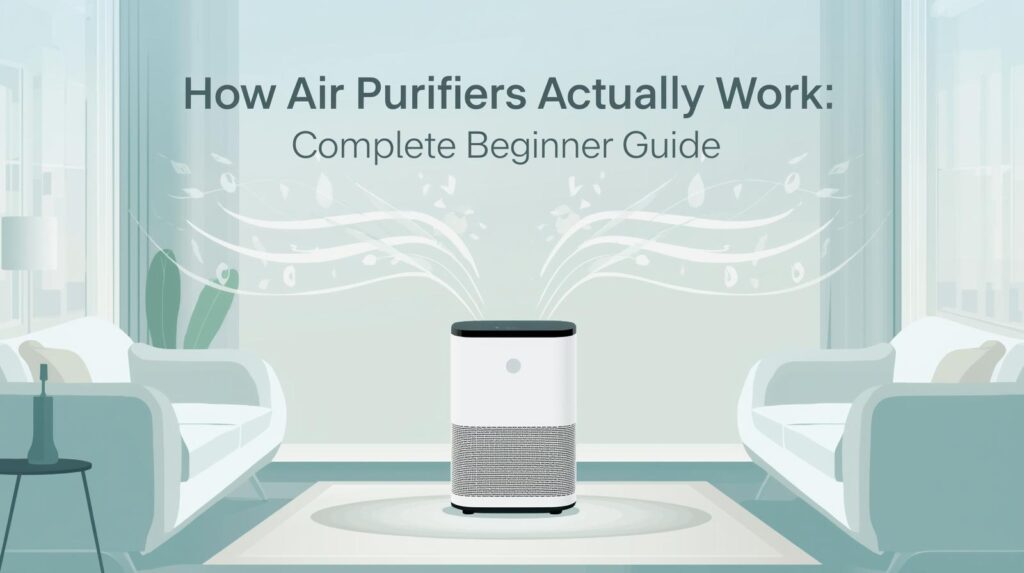
At their core, air purifiers clean indoor air by pulling it through a series of filters that capture particles and pollutants before releasing cleaner air back into the room. Let’s break that down step by step so you understand exactly what’s happening inside the machine.
What an Air Purifier Is Designed to Do
An air purifier is built to improve indoor air quality by removing airborne contaminants.
These typically include:
- Dust
- Pollen
- Pet dander
- Smoke particles
- Mold spores
- Certain odors and gases
It’s important to clarify what an air purifier is not. It is not:
- A humidifier (adds moisture to air)
- A dehumidifier (removes moisture)
- A ventilation system (brings in outdoor air)
Air purifiers work by continuously circulating the air already inside your room and filtering it.
The Basic Air Purification Process (Step-by-Step)
Understanding how air purifiers actually work becomes easy when you see the sequence.
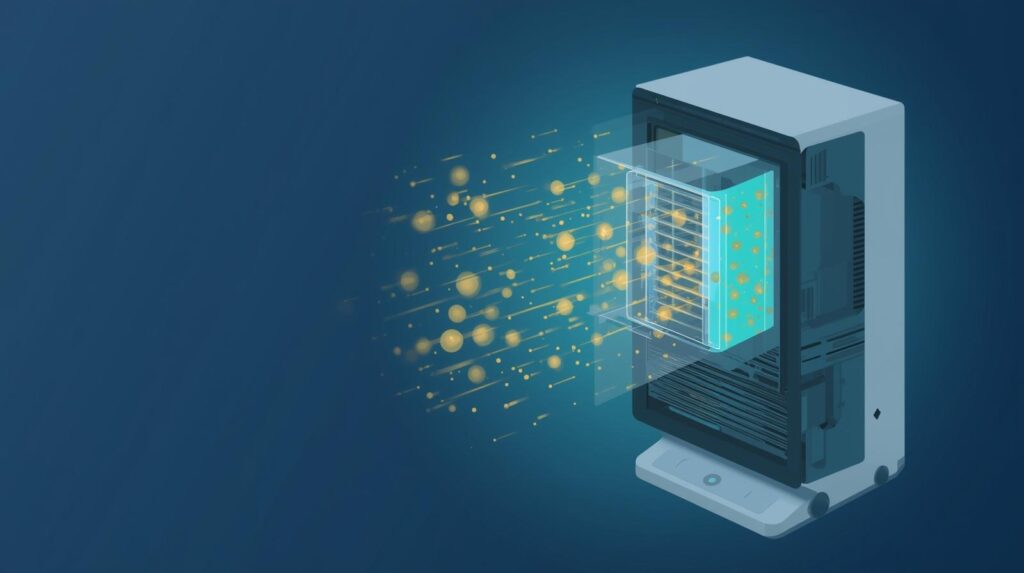
Step 1: Air Is Pulled Into the Unit
A built-in fan draws polluted air into the purifier. This is continuous — the machine cycles air over and over to gradually reduce airborne particle concentration.
The stronger the airflow (often measured by CADR), the faster the cleaning happens.
Step 2: The Pre-Filter Captures Large Particles
The first layer is usually a pre-filter.
This traps larger particles like:
- Dust
- Pet hair
- Lint
This step protects the main filter and extends its lifespan.
Step 3: The HEPA Filter Traps Fine Particles
The most important component in most modern air purifiers is the HEPA filter.
True HEPA filters are designed to capture 99.97% of particles as small as 0.3 microns under controlled testing conditions.
These include:
- Pollen
- Pet dander
- PM2.5 particles
- Mold spores
- Fine dust
The 0.3-micron standard is used because it represents one of the most difficult particle sizes to capture. If a filter can trap that, it can typically capture both larger and smaller particles effectively.
Step 4: Activated Carbon Reduces Odors and Gases
While HEPA filters handle particles, they don’t remove smells or chemical gases.
That’s where activated carbon filters come in.
Carbon filters help absorb:
- Smoke odors
- Cooking smells
- Pet odors
- Certain volatile organic compounds (VOCs)
This makes air feel fresher, not just cleaner.
Step 5: Clean Air Is Released Back Into the Room
After passing through all filtration layers, the purified air is pushed back into the room.
The cycle then repeats.
Over time, repeated circulation lowers the overall concentration of airborne pollutants.
What Is CADR and Why It Matters
If you’re learning how air purifiers actually work, you’ll see the term CADR often.
CADR stands for Clean Air Delivery Rate.
It measures how quickly a purifier can remove smoke, dust, and pollen from the air. The higher the CADR number, the faster the purifier cleans a room.
For example:
- Higher CADR = faster purification
- Larger room = requires higher CADR
CADR helps determine whether a purifier is properly sized for your space.
How Often Do Air Purifiers Clean the Air?
This depends on something called Air Changes per Hour (ACH).
ACH measures how many times a purifier can filter the entire volume of air in a room within one hour.
For example:
- 1 ACH = air is cleaned once per hour
- 3 ACH = air is cleaned three times per hour
More air changes generally mean better ongoing purification, especially for allergy-sensitive environments.
Do Air Purifiers Remove Viruses and Bacteria?
This is where clarity matters.
HEPA filters are capable of capturing airborne droplets that may contain viruses or bacteria. However:
- Air purifiers do not “kill” viruses unless they include specific technologies like UV-C (which varies by model).
- They do not replace medical treatment or proper ventilation.
Air purification helps reduce airborne particle concentration, but it should be seen as a supportive tool — not a medical device.
How Smart Air Purifiers Adjust Automatically
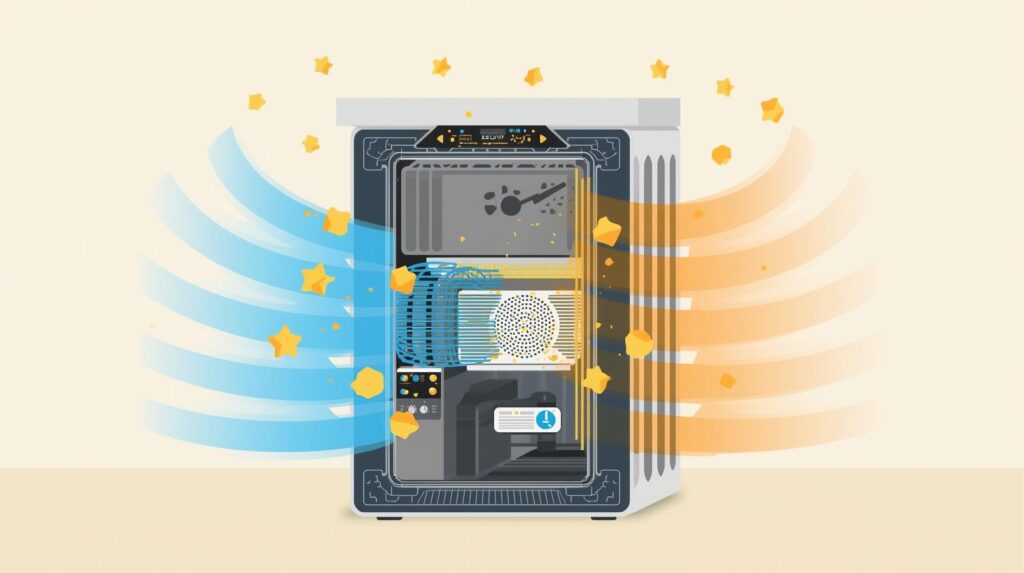
Modern air purifiers often include air quality sensors.
Common sensors measure:
- PM2.5 levels
- Temperature
- Humidity
When pollution levels rise, the purifier automatically increases fan speed. When air improves, it slows down to save energy and reduce noise.
This automation helps maintain stable air quality without constant manual adjustments.
What Air Purifiers Cannot Do
To fully understand how air purifiers actually work, you also need to know their limits.
Air purifiers:
- Cannot remove dust that has already settled on surfaces
- Cannot replace proper ventilation
- Cannot eliminate all indoor pollution sources
- Cannot cure asthma or medical conditions
They are part of an indoor air quality strategy — not the entire solution.
Are Air Purifiers Worth It?
For many households, yes — especially if you deal with:
- Seasonal allergies
- Pets that shed dander
- Smoke exposure
- Urban air pollution
Air purifiers are most effective in enclosed rooms where doors and windows remain mostly closed.
The key is choosing a model sized correctly for your space and equipped with true HEPA filtration.
Final Thoughts
Now that you understand how air purifiers actually work, the decision becomes clearer.
They pull indoor air through layered filters — capturing particles, absorbing odors, and continuously circulating cleaner air back into the room.
What matters most is:
- True HEPA filtration
- Proper room sizing
- Strong CADR performance
- Realistic expectations
When chosen correctly, an air purifier can significantly improve indoor air quality and create a more comfortable home environment.
Cleaner air isn’t magic — it’s filtration, airflow, and consistency working together.